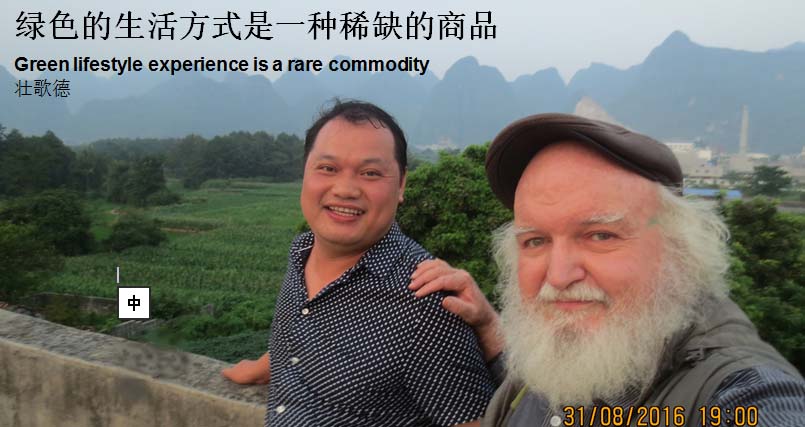
The concept of living a truly green lifestyle is beyond comprehension to most city folks, and even those who understand it and yearn for it may enjoy it only for brief periods. My friend has an important job in the city, surrounded by tar and cement and millions of cars. The city tries hard to supply some greenery, and the city’s vegetables are trucked in each morning so life is not too bad. But every Friday afternoon the outlets to the hills and countryside are jammed with traffic and they have to come back to city life for Monday. The feel and smell and taste, and even a glimpse of true green lifestyle is beyond reach, beyond the senses, and, in its true essence, beyond imagination.
But my friend comes from a rural community where green lifestyle is the only way of life. He goes back there when he can. Recently he took me. Some of the details he pointed out are why city folk can only slap green paint over their polluted, polluting lifestyle. His dad planted the lychee tree 60 years ago. The chickens and ducks supply just enough eggs and meat for the family of 6 live there. The grain comes from 6 mu of fertile land that does not use artificial pesticides. The vegetables on the table are home grown. The air and water are clean. How many dollar millionaires can enjoy this green lifestyle
, and how often and for how long?
The miracle of greenery is that it traps electromagnetic forces from the sun and from the chemical bonds in water, and stores them within carbohydrates that we then eat, releasing these forces for the our body to be maintained, to grow and to move about. We can quantify human actions by estimating how many times a carbon atom in food breaks oxygen molecules that we breathe. The number for an average person for a day in the number 1 followed by 25 zeroes. The basic fact that typically an average person has about half a kilogram of food a day consisting mostly of carbohydrates can be understood as the need for 200 grams of carbon atoms to unleash the required bond forces from oxygen.
Measuring human activity by the number of oxygen molecules broken by carbon is a very useful analytic tool. It can serve as an objective universal currency. The phenomenon is ubiquitous, from breathing, living, moving, to lighting fire, to all factory processes and global industry. Atoms are incomprehensibly small and the coulombic attractions between positive proton and negative electrons are even more of a mystery – invisible, wavelike and untrackable. Yet in a set of units that are anachronistic and of dubious justification, the numbers comparing bond strengths actually show the force released. The number for a bond strength between two oxygen atoms in the air is 118 and when carbon locks in on oxygen the bond is 191. The difference is a force dissipated in all directions, but because they are in the trillions of trillions, given the right circumstances, able to be harnessed and used. That force is what makes up human activity.
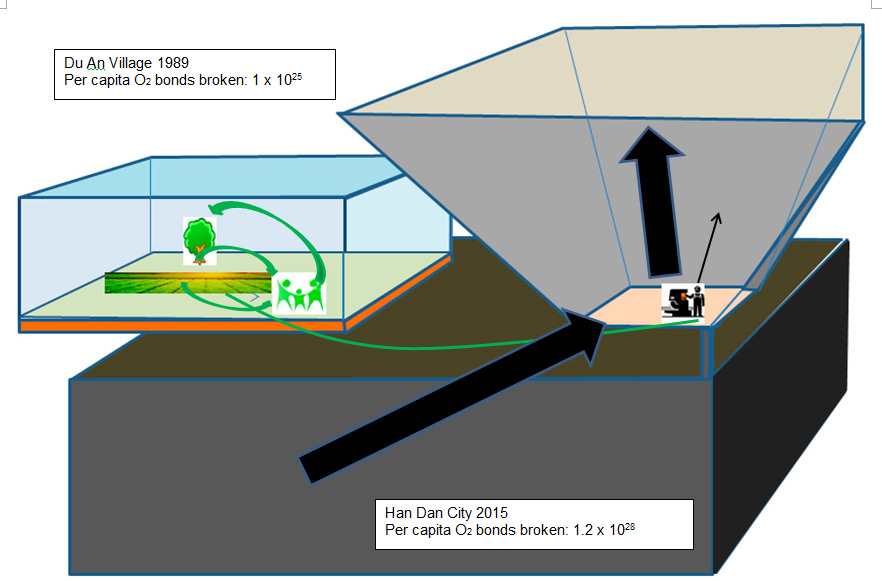
Green lifestyle of Du An Village Man is sustainable breaking 10 trillion,trillion oxygen molecules per day. Han Dan City Man uses fossil carbon to break 12 thousand trillion trillion oxygen molecules per day.
Rather than call the difference 73 calories, we can just count one bond exchange as a single unit and measure them in tranches of some huge multitude – maybe trillion trillion (ie 1018) and make each tranche some money name, in the same vein as penny or dollar. We can call them “oxycarbs” (氧碳) referring to the oxygen’s bond with oxygen trading up to stronger bond with carbon. The exciting fact is this currency is not made up by governments, but is true reflection of reality. All lifestyle was green until it was found that the trade in swapping oxygen with carbon which led to a profitable force release could not only be sourced from live vegetation, but the carbon in fossil fuels. The exchange was not only for eating and living, not just for fires to warm and cook, but to enter into complex processes that burgeoned to be the Industrial Revolution. The combustion in furnaces in one year became next year’s capital equipment, at first ploughs, then steam engines and then billions of tons of new products.
Europeans began in about 1750 exploiting the fact that carbon in fossil fuels could also release the bond force in oxygen. Within fifty years the leafy sprawling towns of north west England transformed cottage industries into acres of blackened foundries and metal mills, pocked by coal mines. The per capita oxygen bond break count went up a thousand times. Instead of an annual carbon cycle and oxygen break-and-remake limited to above ground greenery, a once-only extraction of fossil fuels– about 70% carbon atoms – began and spread around the world.
The dream and desire for a “green lifestyle” can be traced to when societies started to have black lifestyles. “You don’t know what you’ve got till it’s gone”.
A simple sketch shows the vast difference between green lifestyle and modern fossil-dependent existence. Based on studies of idyllic green lifestyle in a village in Guangxi, Du An Yao County 1989, and the unsustainable fossil-dependent case of Hebei, Han Dan City 2015, the daily per capita trade up from oxygen-oxygen to oxygen-carbon bonds was 1 x 1025 for Du An Man and 1.2 x 1028 for Han Dan Man. The ecological footprint of the former is small and above ground, while the latter is a thousand times greater. Every day that amount of carbon is brought to the surface and emitted into the air, already stifling after decades of abuse.
Contemplating the true meaning of a green lifestyle leads to two conclusions which should change what economists and policy advisors are saying.
- Any financial solution is unhinged from reality. The chemical bonds exchanged between carbon and oxygen may be tiny and invisible but they cannot be made up. If plans were made beginning with chemical accounting of the bonds available, borrowing would be a very sobering experience.
- Secondly, the mantra of growth stridently promoted now without challenge would be silenced if where growth was to take place was penciled into this simple sketch. We are already overgrown and bloated, choking on what we are doing to our surroundings. Pubescent growth is admirable. Maturity leads to enjoyment on a plane of what has been achieved in basic material benefits. When economists gloat with glee over growth in the health care sector, be sure that society is very sick.
Current “growth” policies planned in how much money is spent and “made” are taking us further way from any return to a green lifestyle. Counting the oxygen bonds broken is an accounting method that reveals the nakedness of the proponents of financial growth models.
The concept of living a truly green lifestyle is beyond comprehension to most city folks, and even those who understand it and yearn for it may enjoy it only for brief periods. My friend has an important job in the city, surrounded by tar and cement and millions of cars. The city tries hard to supply some greenery, and the city’s vegetables are trucked in each morning so life is not too bad. But every Friday afternoon the outlets to the hills and countryside are jammed with traffic and they have to come back to city life for Monday. The feel and smell and taste, and even a glimpse of true green lifestyle is beyond reach, beyond the senses, and, in its true essence, beyond imagination.
But my friend comes from a rural community where green lifestyle is the only way of life. He goes back there when he can. Recently he took me. Some of the details he pointed out are why city folk can only slap green paint over their polluted, polluting lifestyle. His dad planted the lychee tree 60 years ago. The chickens and ducks supply just enough eggs and meat for the family of 6 live there. The grain comes from 6 mu of fertile land that does not use artificial pesticides. The vegetables on the table are home grown. The air and water are clean. How many dollar millionaires can enjoy this green lifestyle, and how often and for how long?
The miracle of greenery is that it traps electromagnetic forces from the sun and from the chemical bonds in water, and stores them within carbohydrates that we then eat, releasing these forces for the our body to be maintained, to grow and to move about. We can quantify human actions by estimating how many times a carbon atom in food breaks oxygen molecules that we breathe. The number for an average person for a day in the number 1 followed by 25 zeroes. The basic fact that typically an average person has about half a kilogram of food a day consisting mostly of carbohydrates can be understood as the need for 200 grams of carbon atoms to unleash the required bond forces from oxygen.
Measuring human activity by the number of oxygen molecules broken by carbon is a very useful analytic tool. It can serve as an objective universal currency. The phenomenon is ubiquitous, from breathing, living, moving, to lighting fire, to all factory processes and global industry. Atoms are incomprehensibly small and the coulombic attractions between positive proton and negative electrons are even more of a mystery – invisible, wavelike and untrackable. Yet in a set of units that are anachronistic and of dubious justification, the numbers comparing bond strengths actually show the force released. The number for a bond strength between two oxygen atoms in the air is 118 and when carbon locks in on oxygen the bond is 191. The difference is a force dissipated in all directions, but because they are in the trillions of trillions, given the right circumstances, able to be harnessed and used. That force is what makes up human activity.
Green lifestyle of Du An Village Man is sustainable breaking 10 trillion,trillion oxygen molecules per day. Han Dan City Man uses fossil carbon to break 12 thousand trillion trillion oxygen molecules per day.
Rather than call the difference 73 calories, we can just count one bond exchange as a single unit and measure them in tranches of some huge multitude – maybe trillion trillion (ie 1018) and make each tranche some money name, in the same vein as penny or dollar. We can call them “oxycarbs” (氧碳) referring to the oxygen’s bond with oxygen trading up to stronger bond with carbon. The exciting fact is this currency is not made up by governments, but is true reflection of reality. All lifestyle was green until it was found that the trade in swapping oxygen with carbon which led to a profitable force release could not only be sourced from live vegetation, but the carbon in fossil fuels. The exchange was not only for eating and living, not just for fires to warm and cook, but to enter into complex processes that burgeoned to be the Industrial Revolution. The combustion in furnaces in one year became next year’s capital equipment, at first ploughs, then steam engines and then billions of tons of new products.
Europeans began in about 1750 exploiting the fact that carbon in fossil fuels could also release the bond force in oxygen. Within fifty years the leafy sprawling towns of north west England transformed cottage industries into acres of blackened foundries and metal mills, pocked by coal mines. The per capita oxygen bond break count went up a thousand times. Instead of an annual carbon cycle and oxygen break-and-remake limited to above ground greenery, a once-only extraction of fossil fuels– about 70% carbon atoms – began and spread around the world.
The dream and desire for a “green lifestyle” can be traced to when societies started to have black lifestyles. “You don’t know what you’ve got till it’s gone”.
A simple sketch shows the vast difference between green lifestyle and modern fossil-dependent existence. Based on studies of idyllic green lifestyle in a village in Guangxi, Du An Yao County 1989, and the unsustainable fossil-dependent case of Hebei, Han Dan City 2015, the daily per capita trade up from oxygen-oxygen to oxygen-carbon bonds was 1 x 1025 for Du An Man and 1.2 x 1028 for Han Dan Man. The ecological footprint of the former is small and above ground, while the latter is a thousand times greater. Every day that amount of carbon is brought to the surface and emitted into the air, already stifling after decades of abuse.
Contemplating the true meaning of a green lifestyle leads to two conclusions which should change what economists and policy advisors are saying.
- Any financial solution is unhinged from reality. The chemical bonds exchanged between carbon and oxygen may be tiny and invisible but they cannot be made up. If plans were made beginning with chemical accounting of the bonds available, borrowing would be a very sobering experience.
- Secondly, the mantra of growth stridently promoted now without challenge would be silenced if where growth was to take place was penciled into this simple sketch. We are already overgrown and bloated, choking on what we are doing to our surroundings. Pubescent growth is admirable. Maturity leads to enjoyment on a plane of what has been achieved in basic material benefits. When economists gloat with glee over growth in the health care sector, be sure that society is very sick.
Current “growth” policies planned in how much money is spent and “made” are taking us further way from any return to a green lifestyle. Counting the oxygen bonds broken is an accounting method that reveals the nakedness of the proponents of financial growth models.
The concept of living a truly green lifestyle is beyond comprehension to most city folks, and even those who understand it and yearn for it may enjoy it only for brief periods. My friend has an important job in the city, surrounded by tar and cement and millions of cars. The city tries hard to supply some greenery, and the city’s vegetables are trucked in each morning so life is not too bad. But every Friday afternoon the outlets to the hills and countryside are jammed with traffic and they have to come back to city life for Monday. The feel and smell and taste, and even a glimpse of true green lifestyle is beyond reach, beyond the senses, and, in its true essence, beyond imagination.
But my friend comes from a rural community where green lifestyle is the only way of life. He goes back there when he can. Recently he took me. Some of the details he pointed out are why city folk can only slap green paint over their polluted, polluting lifestyle. His dad planted the lychee tree 60 years ago. The chickens and ducks supply just enough eggs and meat for the family of 6 live there. The grain comes from 6 mu of fertile land that does not use artificial pesticides. The vegetables on the table are home grown. The air and water are clean. How many dollar millionaires can enjoy this green lifestyle, and how often and for how long?
The miracle of greenery is that it traps electromagnetic forces from the sun and from the chemical bonds in water, and stores them within carbohydrates that we then eat, releasing these forces for the our body to be maintained, to grow and to move about. We can quantify human actions by estimating how many times a carbon atom in food breaks oxygen molecules that we breathe. The number for an average person for a day in the number 1 followed by 25 zeroes. The basic fact that typically an average person has about half a kilogram of food a day consisting mostly of carbohydrates can be understood as the need for 200 grams of carbon atoms to unleash the required bond forces from oxygen.
Measuring human activity by the number of oxygen molecules broken by carbon is a very useful analytic tool. It can serve as an objective universal currency. The phenomenon is ubiquitous, from breathing, living, moving, to lighting fire, to all factory processes and global industry. Atoms are incomprehensibly small and the coulombic attractions between positive proton and negative electrons are even more of a mystery – invisible, wavelike and untrackable. Yet in a set of units that are anachronistic and of dubious justification, the numbers comparing bond strengths actually show the force released. The number for a bond strength between two oxygen atoms in the air is 118 and when carbon locks in on oxygen the bond is 191. The difference is a force dissipated in all directions, but because they are in the trillions of trillions, given the right circumstances, able to be harnessed and used. That force is what makes up human activity.
Green lifestyle of Du An Village Man is sustainable breaking 10 trillion,trillion oxygen molecules per day. Han Dan City Man uses fossil carbon to break 12 thousand trillion trillion oxygen molecules per day.
Rather than call the difference 73 calories, we can just count one bond exchange as a single unit and measure them in tranches of some huge multitude – maybe trillion trillion (ie 1018) and make each tranche some money name, in the same vein as penny or dollar. We can call them “oxycarbs” (氧碳) referring to the oxygen’s bond with oxygen trading up to stronger bond with carbon. The exciting fact is this currency is not made up by governments, but is true reflection of reality. All lifestyle was green until it was found that the trade in swapping oxygen with carbon which led to a profitable force release could not only be sourced from live vegetation, but the carbon in fossil fuels. The exchange was not only for eating and living, not just for fires to warm and cook, but to enter into complex processes that burgeoned to be the Industrial Revolution. The combustion in furnaces in one year became next year’s capital equipment, at first ploughs, then steam engines and then billions of tons of new products.
Europeans began in about 1750 exploiting the fact that carbon in fossil fuels could also release the bond force in oxygen. Within fifty years the leafy sprawling towns of north west England transformed cottage industries into acres of blackened foundries and metal mills, pocked by coal mines. The per capita oxygen bond break count went up a thousand times. Instead of an annual carbon cycle and oxygen break-and-remake limited to above ground greenery, a once-only extraction of fossil fuels– about 70% carbon atoms – began and spread around the world.
The dream and desire for a “green lifestyle” can be traced to when societies started to have black lifestyles. “You don’t know what you’ve got till it’s gone”.
A simple sketch shows the vast difference between green lifestyle and modern fossil-dependent existence. Based on studies of idyllic green lifestyle in a village in Guangxi, Du An Yao County 1989, and the unsustainable fossil-dependent case of Hebei, Han Dan City 2015, the daily per capita trade up from oxygen-oxygen to oxygen-carbon bonds was 1 x 1025 for Du An Man and 1.2 x 1028 for Han Dan Man. The ecological footprint of the former is small and above ground, while the latter is a thousand times greater. Every day that amount of carbon is brought to the surface and emitted into the air, already stifling after decades of abuse.
Contemplating the true meaning of a green lifestyle leads to two conclusions which should change what economists and policy advisors are saying.
- Any financial solution is unhinged from reality. The chemical bonds exchanged between carbon and oxygen may be tiny and invisible but they cannot be made up. If plans were made beginning with chemical accounting of the bonds available, borrowing would be a very sobering experience.
- Secondly, the mantra of growth stridently promoted now without challenge would be silenced if where growth was to take place was penciled into this simple sketch. We are already overgrown and bloated, choking on what we are doing to our surroundings. Pubescent growth is admirable. Maturity leads to enjoyment on a plane of what has been achieved in basic material benefits. When economists gloat with glee over growth in the health care sector, be sure that society is very sick.
Current “growth” policies planned in how much money is spent and “made” are taking us further way from any return to a green lifestyle. Counting the oxygen bonds broken is an accounting method that reveals the nakedness of the proponents of financial growth models.
Two snippets from radio – 1.caveman baby tooth 150,000 years old can reveal age, gender , type of diet and extent breast feeding.2 Rocket on Gaza hospital killed 500, peace talks off.
I came across a story that makes my mind spin. There is a school bus service from Urbenville/Woodenbong to Kyogle 5 days a week and Thursday they also have a return 11 am for pensioners. During lockdown here it was just driver and me on Thursdays, and sometmes one or two ladies. When most shops except essential foods were shut, shopping took half an hour and had a good chat to the other passenger(s) waiting for 11 am departure. One lady was about 80 and got on near a place where one of my classmates 70 years ago came from. Yes, she remembered her. Nice talk. Welsh accent. Came from Wales 1951 on sponsored settlement program.
When she got off the bus the other passenger briefly mentioned that the lady lived with her son. She had had a beautiful big homestead up on a hill. Timber, and verandahs all around. Burnt to the ground two years ago and she got out in her nightie. Husband was in Lismore Hospital at the time. I was told this in a hushed whisper. Then the voice got quieter and she it had been teens from highschool who also rode the bus. There was a teacher on the bus got off at that place and was so hated that they had come back at night to burn the house down. There was indeed a rented farm house a few hundred meters away. But they got it wrong and burnt the homestead down instead. Then end of story. So sad and touching I was made aware not to ask. I did ask another mate lives on the same road. Never heard of it. In an email I asked the old classmate from 70 years back. She knew but said nothing else.
Today was the next Thursday and in the shops I tackled the second passenger – how could kids burn down a house because they thought a teacher lived there??? In this nice quiet place. I got no answer. On the bus back the old lady got out and I could see the sons house she was heading and then I noticed the site of the burnt down homestead – flat and charred. I starred at my copassenger. Who would do that? Shook her head. Were they kids too little to realize they had attempted murder? Were they highschool aborigines from Urbenville?? She blinked. Oh. Unmentionable. That is why no trace of news on internet. Set my mind spinning.
I tried to imagine the talk. You white fellas burnt down our homes before. Yeah sometimes you meant to punish bot you got the wrong homes and the wrong people. Shrugged shoulders. No good saying “we respect the traditional owners”. Starting 200 years ago explorers, pioneers and settlers came through the upper Richmond. In that era the British mindset treated local aborigines as savages. Tolerated if they could be enticed into peaceful settlement. Otherwise hunted out of the area. Where they “lived” was nothing like a big homestead. But it had been where they lived.
I feel deeply sorry for the lovely lady and her husband had their house burnt down. 70 years of memories and treasures. Had just bought a new expensive piano. But what some early settlers did was just as hurtful and irrational as what those highschool kids did. It is a deep and wide gap in failure to bridge cultures. I think we are generally doing better now. Hurts when there is jolt from the past.
A characteristic of internet messaging is that mostly it is untraceable. If you get a message where the sender does not self-identify, you cannot go back “up the line” to the origin. This can be a big negative when the sender is criminal/terrorist etc. It can also be advantageous if you have valuable information but don’t want to disclose the source.
Money is a bit like this. We have money and no one except in certain parenting situations or very strict regimented regimes will ask where did you get the money from. Money has no identifiable history. This is so obvious we do not worry about it
, but it allows cheating.
Once money has been illgotten and then appears in a new setting, spending is welcomed.
Now the internet web has a new invention – blockchain. Anyone entering the web and messaging leaves a trail where backtracking is blocked. You take a step like making a new link in a chain, and that is recorded and unalterable. Very good for people of good motives.
Can a money be created where its history is stamped?
Here is how I see it. At highschool the boys were macho and egged each other on like Animal House (the movie Kavanah mentioned at hearing). They did discuss two men having sex with a woman (devil’s triangle). They did get very drunk. Once they were very drunk and they tried it on Ford. Note her strong recollection of them laughing at her expense. Strong laughter. They were enjoying the idea. Very sick and twisted and driven by a desire, not of sexual gratification but to show off. Fortunately they were so drunk she could escape. Of course they remember. Of course they deny it and in any sober situation would not try to gratify sex desires by rape, mainly because of the jail time it incurs. And of course if sober would not show off by even starting the actions they did.
So it is very real for the 15 year old Ford, and real to this day. To Kavanah and Judge it is a horror they wish never happened, and can only excuse that they were very very drunk, bordering on being physically incapable of rape.
One of the Yale class mates in the other accusation commented the boys were more intent on impressing each other than actually making a hit on the girls.
Kavanah knows he is lying and the reality is so horrible he wont admit. It was not what would be classed as a “normal” attempt at rape driven by sexual desire
, but extreme need to have an incident to boast about. Absolutely stupid and can be categorized as criminal. That is what I think happened. I can presume Kavanah went on to live a “normal” life after Yale and is in no danger of “more attempted raping”. From the little we saw and heard on TV he does not seem fit to be on the Supreme Court. Very phony.
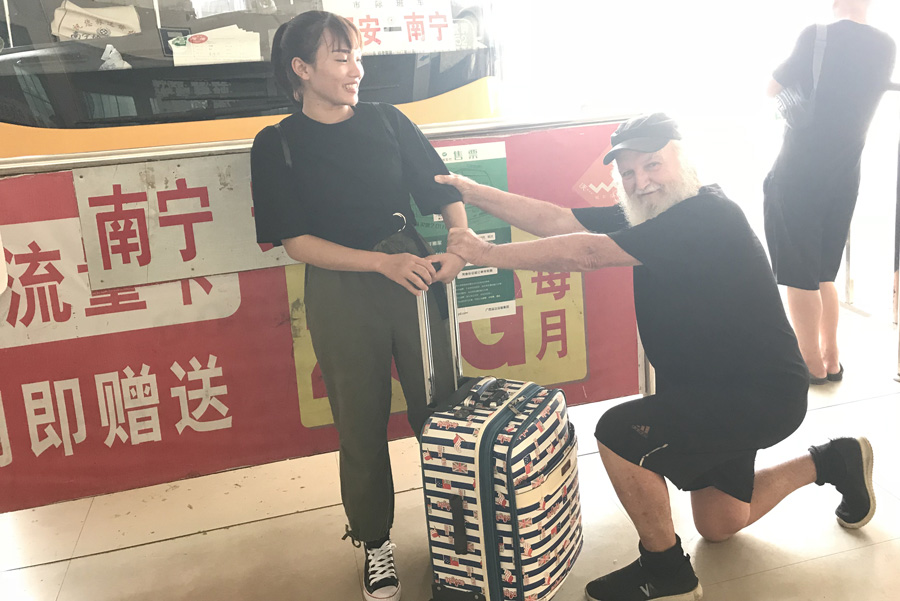
Mid-September is the start of the academic year in China and highschool grads begin life at college. In Du An County, a Yao minority area in the mountains of southwest China where I research and write on science, I have lovely friendships with kids of the 3 highschools there, keen to practice English and also to genuinely make me welcome. It is a quiet, safe charming rural society which is why I live here. The school system supports the mountain kids in dorms during their formative years. Like a pleasant prison, only allowed out Sunday afternoon 1 to 6pm, no idea of wider world, no TV and mercifully never heard of “Te Lang Pu” (Trump). I followed quite a few of the kids’ big step out into the big world (including posing at the bus station pretending I am pleading one not to leave – posted on my facebook). Another one I followed by wechat messages leaving here at 8 am and after many travails at interchanges arriving at a 4th tier city to be shuttled to a rather obscure college where the national exam computer system had matched her highschool score with “tea studies” (yes that is a 4 year course in China). At 11 pm she was messaging gushing that she had met someone real friendly and warm. He was a foreigner and could only speak English to her (which she is very poor at). It is a fact that some developing countries send kids here for low level uni courses). She copied some of his text because they communicated by auto translate.
I was unnerved to note he came for a country frequently in the news because of the dominant traditions that treat women horribly. Women are required to have all skin covered and dress otherwise can be justified reason for rape. His texts were offering to “help” the new arrival and intimated she could come to his kitchen and he would cook for her. “My dorm is close to yours”. I have had previous close experience with guys who had freaked out at first sight of girls in shorts and a hint of cleavage. I texted back be careful and that his country was not like where you come from
, with some links to background on problems for women in places where they are not respected.
Why can’t the world be like Du An County where sexuality is neither commercialized to the brink of porn nor taboo that goes berserk when unleashed.

Just jotting a couple of thoughts about out time as trainee army pilots at Point Cook Airforce base.
Recall we were treated very much as second class, being army on and airforce base (by general personnel – not by our instructors, who were tops).
Recall talking about what we wanted to do and Andy Westman said he wanted as many engines under him as possible. That was a new idea to me. I just wanted to skim over the land like an aerial motorbike.
One instructor at the outset said he didn’t want trainees with bad habits. He wanted a blank sheet to work on. I thought “that’s me”. I really had not thought about how to fly. Couple of minutes straight and level in my brother’s second hand Auster was the reason I joined the army. Later when I had been scrubbed and I came back to see mates at end Andy fessed up that he had a fair bit of training before (that he had not admitted).
At a written exam
, signals or communication or meteorology – I forget, I sat in the front and when papers were handled out with multiple (4) choices per question, bugger me if I could see the indent marks from a paper that had been on top, presumably the right answers chosen by the instructor. I looked around and wondered if it was an honesty test. I figured it wasn’t, and anyway the questions were hard for me so I just followed the indented ticks. I though this is gonna look funny so I messed up one question. When we got the results there was awe from instructor and mates that I only had one wrong. And some smart alec chimed in that it was an easy one.
There was an open cockpit plane on stilts down the back, maybe reject from a museum. I went down with a leather helmet, took out my top and bottom false teeth and gave a gummy smile and thumbs up for a photo and it did the rounds captioned “Sleep week, your airforce is ready to defend you”.
A Navigation Instructor we had was Al Pinches. I had a neutral impression of him. He did his job, that’s it. But a couple years later I read he was missing in a Canberra bomber over Vietnam. I thought that was end of that. Then when I was at Griffith Uni Asian Studies he turned up as amature student couple of years after me. He had had a wing shot off, ejected, and rescued next day. Traumatic encounter with potential capture. I don’t think I ever said hello to him. Those days essays were marked and scattered around a big desk in admin and when I went to collect mine, one caught my eye cos of all the red annotations. It was Al’s paper something about Vietnam and the marker was Prof Colin Mackerras, who is extremely soft on communism. Hilarious to read the comments. Al had had rough treatment and Prof was telling him he was biased. You betcha!
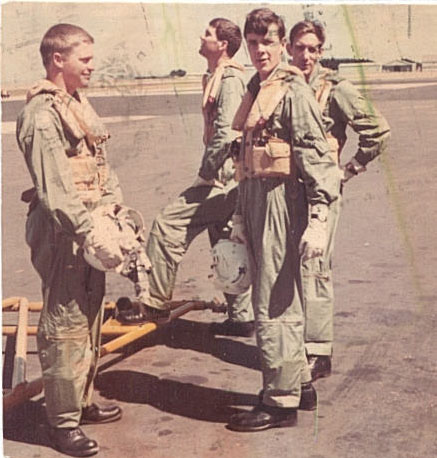
I don’t like war. Stupid. Insane. I don’t want to talk about it again. I was in one. I want list a few thoughts and memories while in my own room and then leave it at that. I don’t want to get dragged back into conversations and triggers of those times.
This was all based in Laos and the eastern border with Vietnam and north border with China and the west with Burma. Walked through a minefield and when got to the other side the rafferty soldiers lined up and were stunned that I had made it and then came and fondled my ankles, murmuring, like I was a ghost to be honored. Only later did I realize it was a miracle.
At Luang Prabang Airport the Colonel was trying to get me to do something that was wrong. Bomb people we shouldn’t. I told him the CO (the Prince, and brother of the King) did not agree. We walked into the CO’s office and he told it like I said. Then we went outside and Colonel repeated his orders and I realized the CO was just a joke.
In a DC3 with no seats, just a hold full of village people and I dunno who
, we were flying from Luang Prabang to Ban Houie Sai. I went into the cockpit and there were two pilots and that Colonel. I backed off smart. Soon the Colonel came back to the hold and his mind was considering throwing me out. I knew it happened when there was conflict of goals. I got in with the villagers who were friendly and I made light with them. The Colonel weighed it up and went back into the cockpit.
There were some hippies in Vientianne and Luang Prabang that I would drink Ovaline with and hear their meandering opinions. They seemed unified on the story that the US and Lao army were running in drugs. I was naive and refuted that. But it was in Ban Houie Sai I saw the drug industry and transport system. If I had taken a photo they would kill you.
I did time placed in front lines with infantry as observer for air strikes. The platoon was camped beside a village which was nice for social comfort but made dangerous for the villagers. We got eggs and honey and honeys. The captain spoke French and the second lieutenant English. It was surreal situation. We would drink rice whiskey on the banks of the Mekong and fish with handgrenades. But at night get mortared. We would call in the Stookies, DC3s with 3 vulcan guns mounted to fire through the windows and they would rain bullets down on the sources of the mortars. Each vulcan fires 600 rounds a minuet. Tracers formed an arc from the plane down the mountain on the other side of the Mekong. That area must have a concentration of metals higher than any mine.
I was with one private soldier walking and instead of clinging to the bush he short cut across a rice field. I was perplexed. There was enemy. He told me he would run if there was a warning shot. Warning shot? Well they would shoot you first – that is my warning shot.
We had a gun boat on the Mekong at camp and it came under fire and a guy I knew fell in the water as they tried to make a run for it. I ran into him, later at the airport and he had a bullet wound in the shoulder but was going back. He was super nonchalant. I had thought he would be dead.
My first encounter with open gay guy certainly caught me unawares. He was flaunting his drag. As an Aussie from the bush, 1971, I reckoned this was a lark, and joked with him. He wrote his address and later I visited. Didn’t take long for him to show me porno of what he wanted me to engage in. I was shocked and politely left. I learnt his dad was a macho army major in the jungle and revered by his men for his toughness. Could not help thinking his son may have reacted to that extreme in a father.
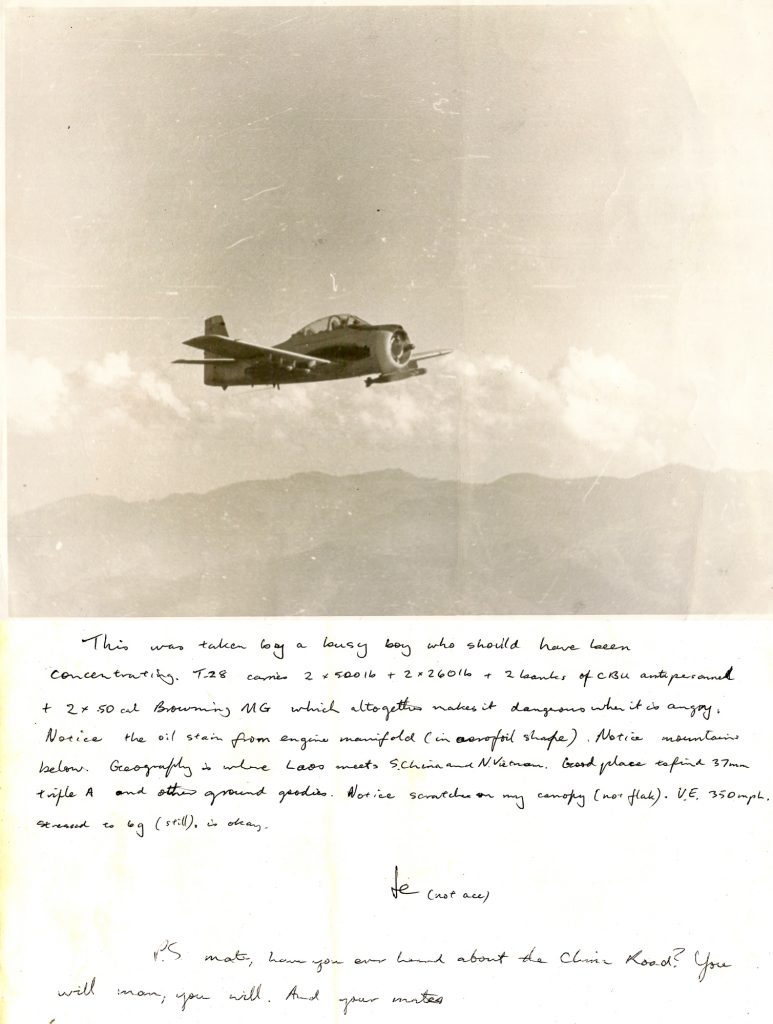
February 1971 had 28 days and my plane did 198 sorties.
I was walking across the tarmac and a T28 landed with a rocket that had not fired. It dislodged on landing and streaked into a line of parked T28s at the side. Huge ball of fire. Lao personnel were running round yelling Bopin Yang (“doesn’t matter”). I will remember that line.